I look around and, out of the corner of my eye, notice the waiter casting disapproving glances at my daughter, who is running between the tables, laughing loudly—and all I can feel is… well… embarrassed. I think I know what they’re thinking: “Where is that child’s mother?” (Sometimes it’s “Where is the father?”, though much more rarely—but that’s a discussion for another day.)
And I start thinking, “Why, just why? How is this little girl already running around between people who are trying to eat again?”
It’s the first adult conversation I’ve had in months, and I can’t finish it. So the internal debate begins: “Do I go get her or leave her be?” In reality, the choice is often between:
“I’m feeling unsettled, I’m going to put an end to my discomfort”
VS
“Do I manage my own feelings and give my daughter the freedom she needs, after sitting at the table for over an hour, to move around?”
And I look around and see children the same age, sitting with their tablets, phones, or similar devices (now even watches have games), disconnected from what’s happening around them—glassy-eyed—and who burst into tears when the episode ends or the game freezes.
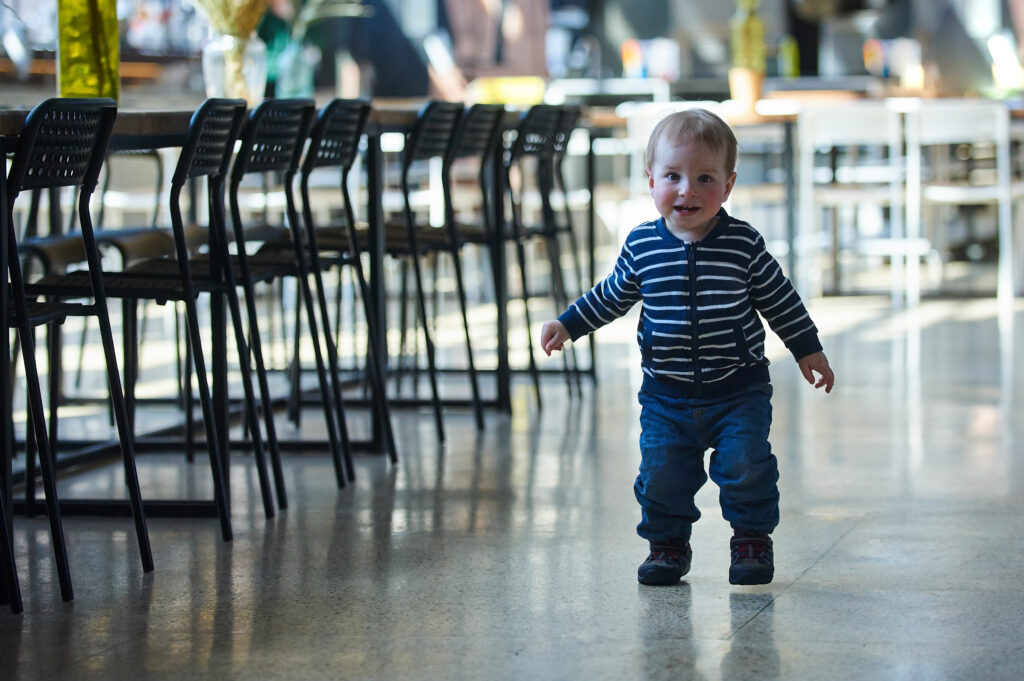
I remind her that she needs to be mindful of others, who have the right to enjoy their meal in peace, and I softly sing to her: “Under the roof we use a quiet voice; outside in the open air, we can shout!”—a little rhyme created by my goddaughter (2 years old) and her mother.
And so, I let her run.
Next time, we’ll go to a child-friendly restaurant. Wouldn’t it be nice to go somewhere where we know children’s normal behaviour doesn’t trigger eye rolls and barely concealed sighs? Search: Restaurants with policies “Suitable for healthy children: loud, jumpy, energetic, and full of contagious laughter.” Results: Zero. Great.
Situations like this raise many questions. But in the end, what behaviour are we actually expecting from the child?
These are questions we ask ourselves over and over again. However, it may be more relevant to ask: Why do we want children to stay seated? Why don’t we want them to get up?
In these situations, assessing the context is often very revealing. Try to observe:
Small questions, huge impact.
But what lies behind this behaviour?
In the first years of life, the child’s body is their main way of exploring.
Movement is not an “extra.” It is a need. Staying seated for long periods, in environments that are not well adapted to their needs, can quickly become too demanding.
And when that happens, behaviour changes. Not as a challenge, but as a response to what their body is asking for.
This doesn’t mean “anything goes.” But it also doesn’t mean the only solution is to demand behaviours the child is not yet ready for. The point lies in the balance between respecting others and respecting the child’s needs.
Restaurants and children don’t always go very well together. Most places are not designed with young children in mind. And that’s not a problem in itself, but it is important to recognise it. Sometimes, the solution is not to “correct” the child, but to adjust the context whenever possible.
Between a child who runs and a child who sits still, absorbed by a screen, it’s worth pausing to think about what lies behind each of those realities.
Because the most socially accepted behaviour is not always the one that best meets the child’s needs.
If you’d like to look at these situations with more clarity and make more confident decisions in your daily life, you can find more information here:
And how about you? How do you usually experience these situations?