If you’re trying to decide between daycare/a nanny or staying at home with your baby, know that you are not alone.
This is one of the most difficult decisions for many mothers, especially when returning to work means entrusting your child’s care to a daycare or a nanny.
I’ve come across this question many times.
Mums on the verge of a breakdown because they have to—or want to—return to the workforce, but that means leaving their babies in some form of childcare, whether a daycare or a nanny, when family is not an option. The doubts start to build up, and they begin to question themselves:
Is there a right answer?
I don’t advocate for one option in particular because, depending on each family’s circumstances, every choice comes with its own advantages and disadvantages.
“Ah, but children only benefit from going to daycare or having a nanny because they need to socialize, learn to share, understand social rules, and see how the real world works.”
No.
In the early years, children do not seek out others in the way we often imagine.
True socialization begins around the age of 3. Maria Montessori referred to this stage as “solitary play,” which can span from around 3 months to 3 years. In other words, babies are not genuinely interested in others—their focus is on themselves, their needs, and their interests. By definition, this is an egocentric phase, where playing with others and sharing toys does not yet have a place.
Play is, above all, individual and centered on exploration. This has been described in various developmental theories and was also observed by Montessori through her ideas of concentration and independent work.
Do they interact? Of course. An adult—or another baby—shaking a toy in front of them will almost always trigger a reaction, whether visible or not.
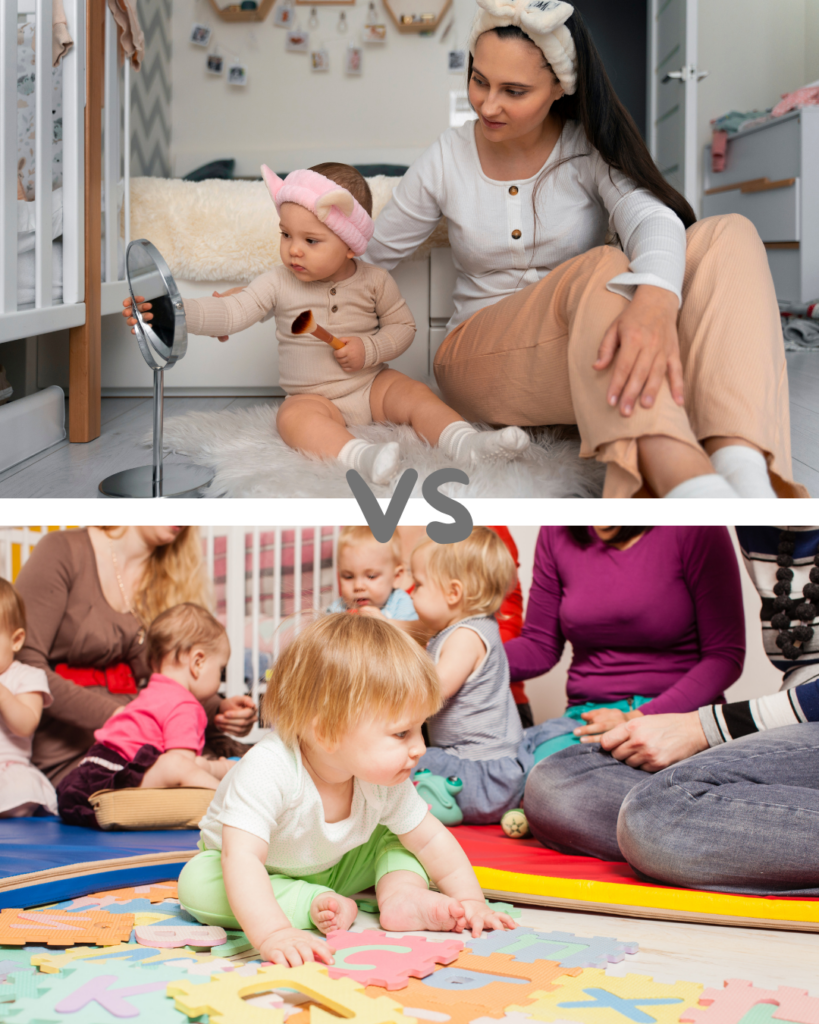
What truly influences development?
Modeling positive behaviors is essential for children’s development, but it doesn’t happen only in daycare or with a nanny. It can take place anywhere the baby is, as long as the adults adopt an appropriate approach.
Of course, in daycare, surrounded by other babies who are just as egocentric, situations involving sharing will arise much more often than they would at home, even if the child has a sibling.
But the key point isn’t how often these situations occur, it’s how adults respond to them.
It’s the way adults interpret and respond to conflicts, including moments of “not sharing”, that determines the learning potential of these experiences.
In other words, it’s not the setting itself that teaches children to share, it’s the quality of the adult’s response.
It’s also important to clarify that the ability to share does not depend solely on social learning or repetition, it depends on developmental maturity.
It is linked to the development of executive functions and self-regulation, neurological processes that are still maturing in the early years of life, particularly in the prefrontal cortex. That’s why the ability to share doesn’t emerge because an adult demands it, but only when the child is developmentally ready.
How can you make a conscious decision?
Is it better to go to daycare or have a nanny? No.
Is it better to stay at home? Also no.
It all depends on the conditions and experiences your baby will have in each setting. Assessing the options and circumstances is essential when making a choice, if you have one.
If you’re considering placing your baby in daycare or with a nanny, try, if possible, to observe:
It’s the real, day-to-day conditions your baby will experience that determine whether attending daycare will be beneficial, or not.
If you’re considering staying at home,it’s also worth taking a moment to reflect on yourself:
Are you emotionally ready for that choice?
Often, we believe we are, but there’s a part of us that quietly resents having to give up our career. A longo prazo irá refletir-se no seu estado emocional e poderá impactar a qualidade da relação com o seu bebé.
Weigh both sides, both are valid, but the choice is yours.
There’s no long-term benefit in a choice that feels like a sacrifice.
If you’d like to deepen this perspective and apply it to your daily life with more clarity and confidence, you can find more information here: